William H. Cross Expedition to Chattooga, Georgia, James H. “Sloppy” Floyd State Park, July 06-10, 2026
by Joseph H. MacGown, uploaded on 21 July 2026
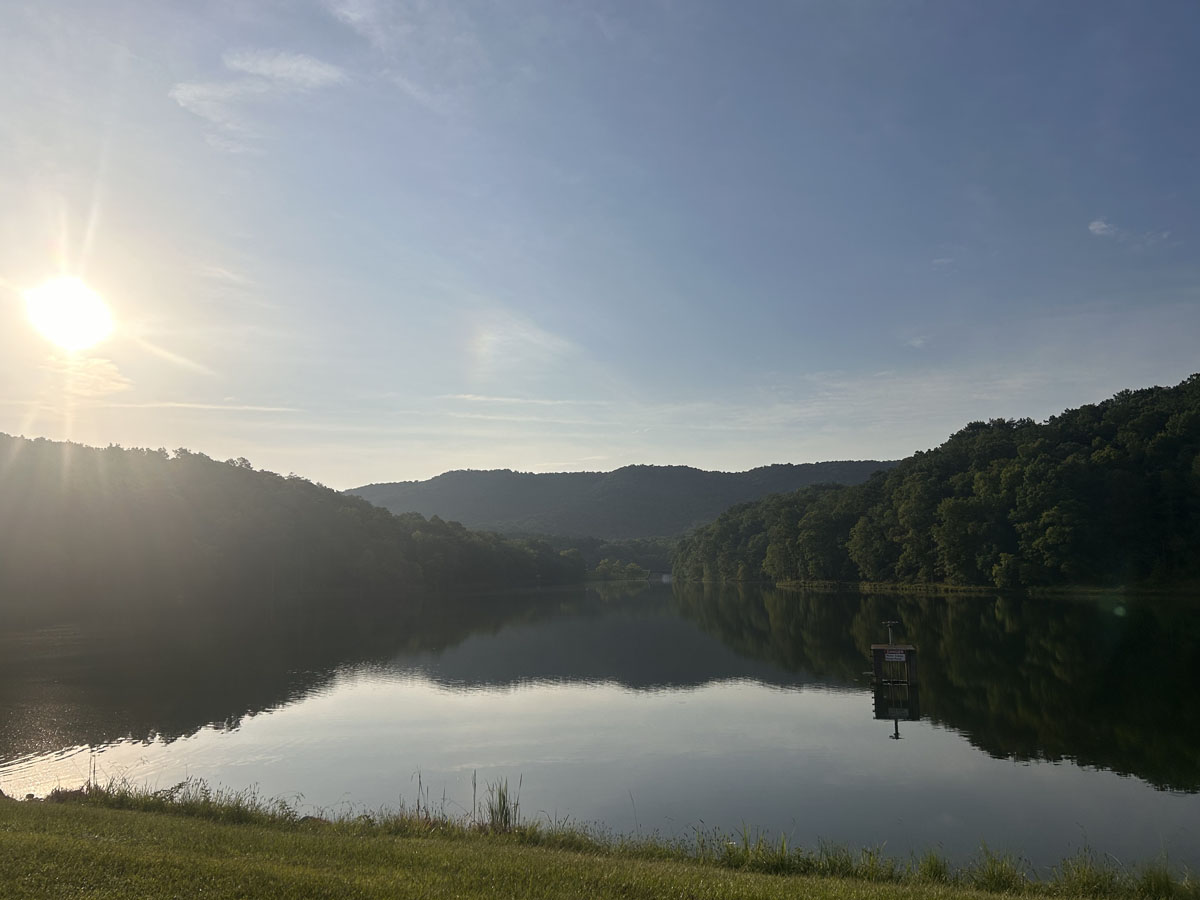
Sloppy Floyd State Park, Chattooga County, GA
The 2026 William H. Cross Expedition took place from 06 to 10 July 2026 in Chattooga county, Georgia and the surrounding Walker and Floyd counties. We stayed in cabins and collected at James H. “Sloppy” Floyd State Park, as well as a variety of other localities within 30 minutes or so drive from the park. James H. “Sloppy” Floyd State Park is located in a beautiful mountainous forest habitat in North Georgia and is surrounded by the Chattahoochee National Forest and rural countryside, with lakes and rivers running through it. Other noteworthy nearby localities included Black’s Bluff Preserve, a variety of spots along the Crockford-Pigeon Mountain Wildlife Management Area and Coosa Prairie remnants within the Campbell Timberland Management Coosa Valley Prairie Easement. Across the various localities a range of habitats were visited, including the mountainous outcrops of Conansauga limestone with unique and diverse plant life at the Black’s Bluff Preserve; a mountainous segment of the Cumberland Plateau with its exemplary dense hardwood forests and hidden caves along the varying elevations of the Crockford-Pigeon Mountain WMA; and the rare biodiverse Coosa Prairie remnants amongst a young timber woodland at the Campbell Timberland Management area.
Attendees
Participants for the 2026 William H. Cross Expedition included JoVonn Hill (MEM director, grasshopper specialist), Richard Brown (retired MEM director, moth specialist) Anthony Deczynski (Curator, beetle taxonomist), Nicole Rasoamanana (Research Associate, ant specialist), Phillip Barlow (Research Associate, bee specialist), Darby Tassell (Lab Technician and PhD student working with velvet ants), Masab Alkhalaf (Master’s student working with grasshoppers), and Joseph H. MacGown (Research Technician).
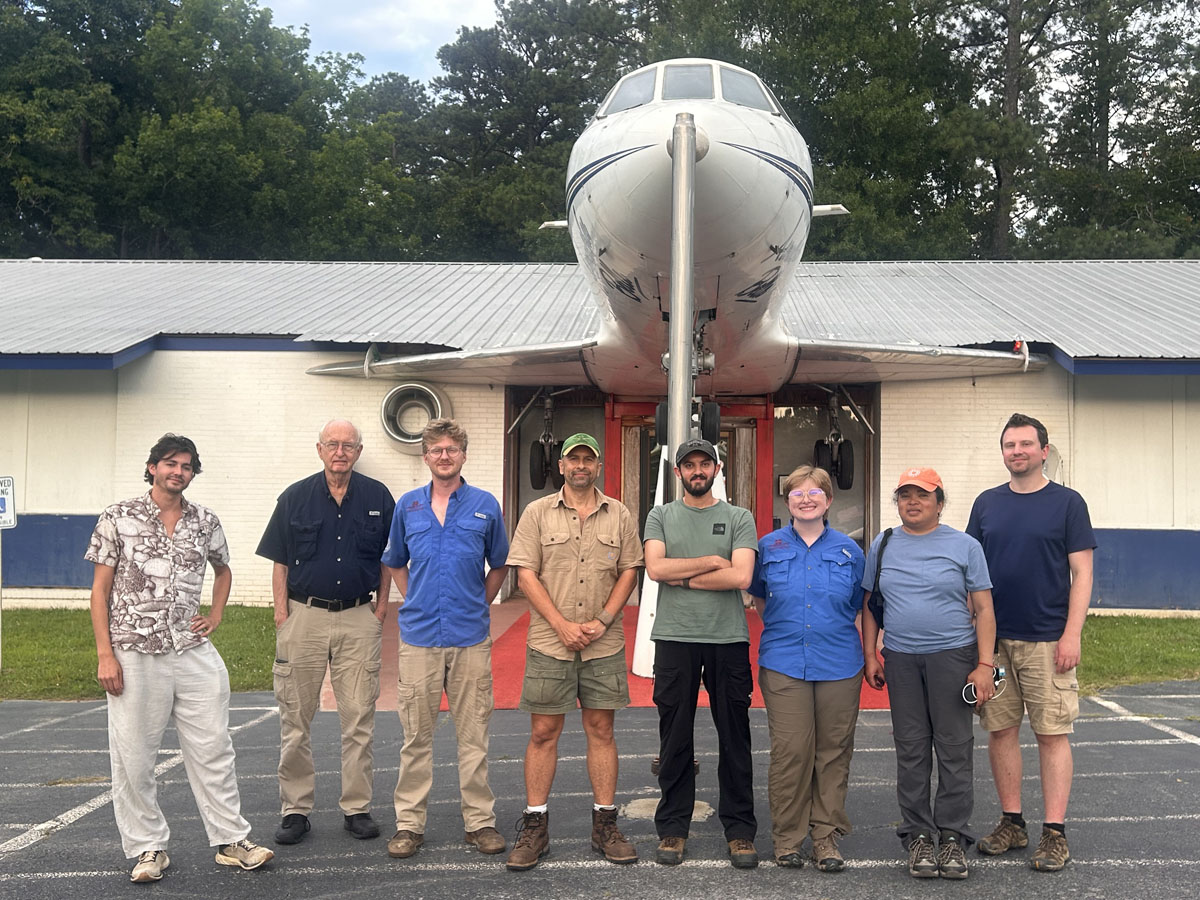
Participants in the 2026 William H. Cross Expedition Joseph, Richard, Phillip, JoVonn, Musab, Darby, Nicole, and Anthony (from left to right).
Traps and Methods
Blacklight trap, bucket trap, mercury vapor trap, Malaise trap, Berlese funnels, general collecting, sweeping, aspirator, baiting (e.g. Pecan Sandies cookies, peanut butter), bee traps (bowls and blue vane traps).
Monday, 6 July 2026, James H. “Sloppy” Floyd State Park (JHSF)
After driving through winding high incline roads that cut through mountainous forest we arrived at our place of stay, James H. “Sloppy” Floyd State Park, named after a former Georgia Representative by the same name. Though I could find no information on the matter online, we were told from our accommodating host at check-in that the nickname came from the former representative’s younger years as an exceptionally scrawny football player adorned in oversized jerseys and pads, a “sloppy” aesthetic. Evidently it was a noteworthy visual as the pervasive “Sloppy” nickname stuck through his years in government, and in the park and memorial building named after him later on.
Upon arriving at the cabin site, as is typical on these expeditions, we unloaded gear and set up a variety of passive traps (blacklight traps, a mercury vapor trap, a Malaise trap, a bucket trap with UV light, and Berlese funnels). After setting up traps and unloading, it was time to figure out our plans for food. A group of us went to a nearby Ingles in search of groceries and restaurant recommendations for Summerville, Georgia. That lead us to a local’s favorite Mexican restaurant, Dos Maguey’s. As it was the majority of participants first William H. Cross Expedition, Dr. Richard Brown discussed the origins and history of the expedition series over our oversized quesabirria portions.
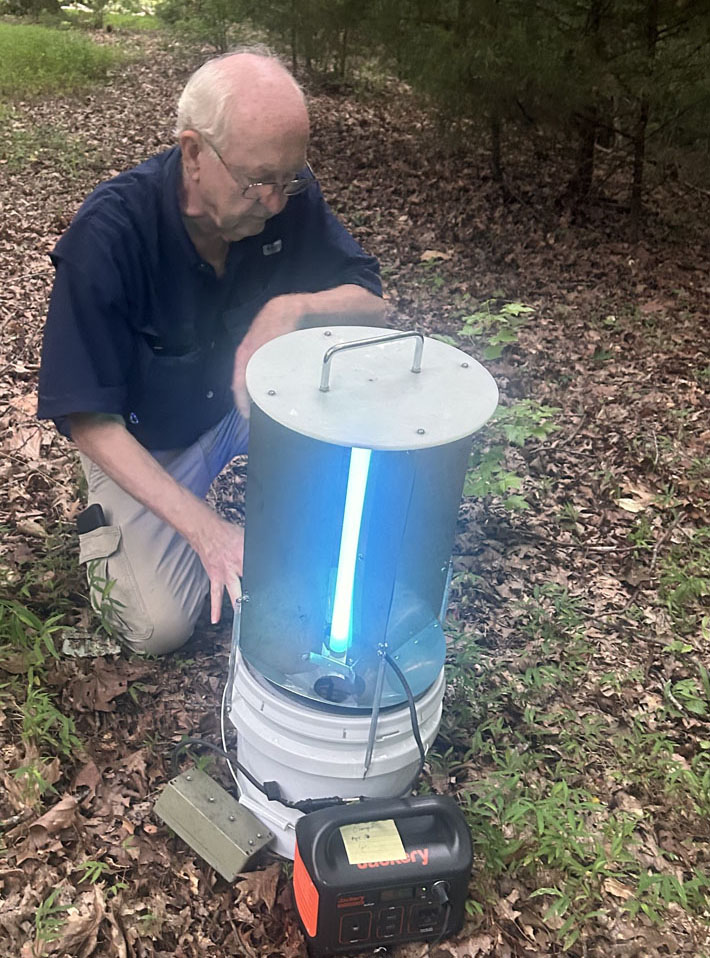
Richard setting up a UV bucket trap near cabin site.
He told us many stories about William H. Cross, former director and founder of the Mississippi State University Entomological Museum (MEM). After Dr. Cross’s unexpected passing on an entomological research trip, shocked friends and peers wanted to memorialize him and his dedication to science, entomology, and adventurous insect collecting. Thus Dr. Brown, alongside other passionate supporters, started this annual insect collecting expedition, traveling to a new location for surveying every year. All insects collected on such trips have been labeled with “William H. Cross Expedition” in his memory, providing ample specimen additions to the museum collection, and, ultimately, a wider understanding of entomology as a whole.
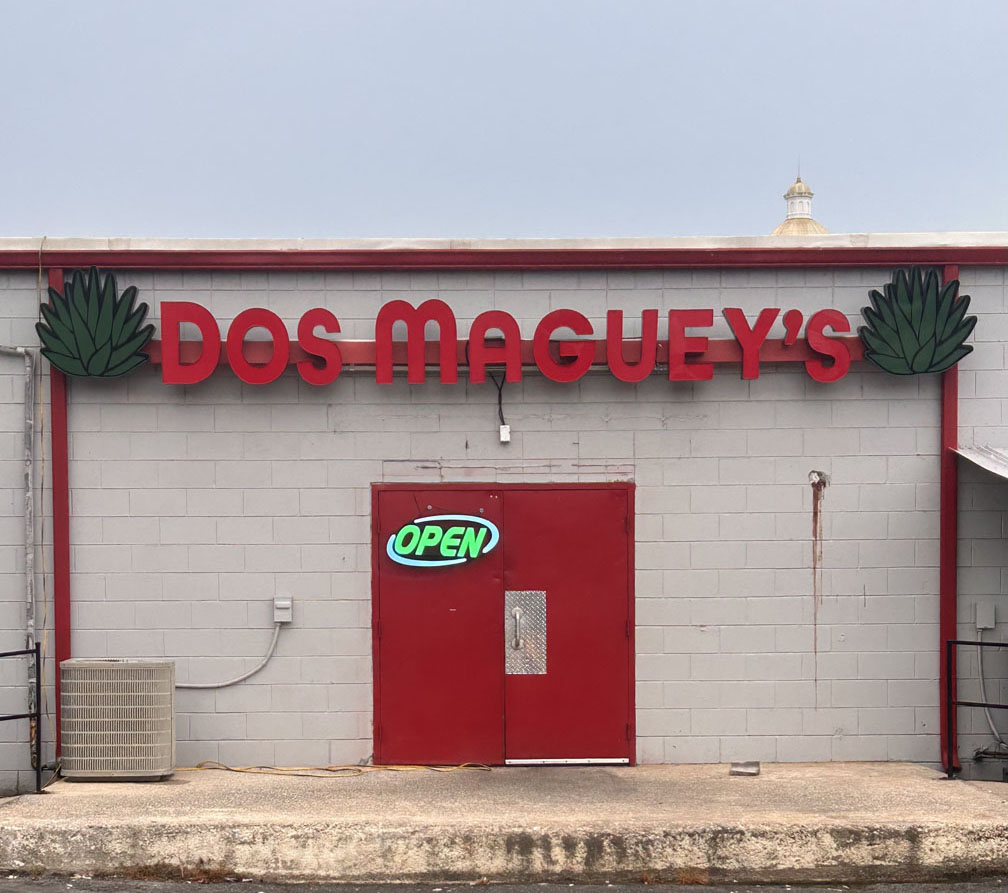
First dinner of the Cross Expedition at Dos Maguey's.
After getting full on food and stories, and as the darkness of night set in, we went back to our cabin site traps for nocturnal specimens; two blacklight traps and one mercury vapor trap. Everyone darted back and forth from a mercury vapor trap in the woods behind the cabins, to a blacklight trap on the porch of cabin 1, and to an additional blacklight trap in a wooded area near the cabin site. Everyone was excited to see what insects might dwell in an unfamiliar place at night, so we stayed up late collecting.
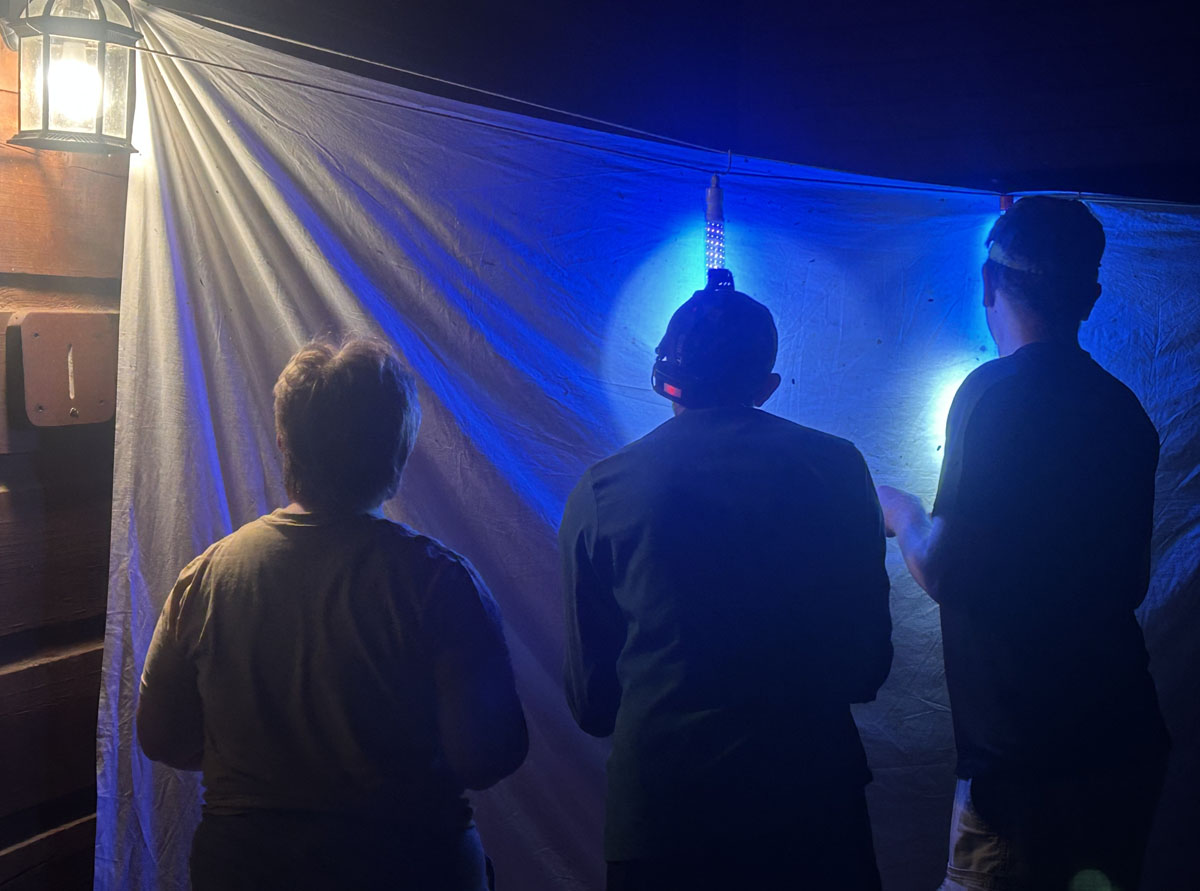
Darby, Musab, and Anthony (from left to right) inspecting the cabin blacklight trap.
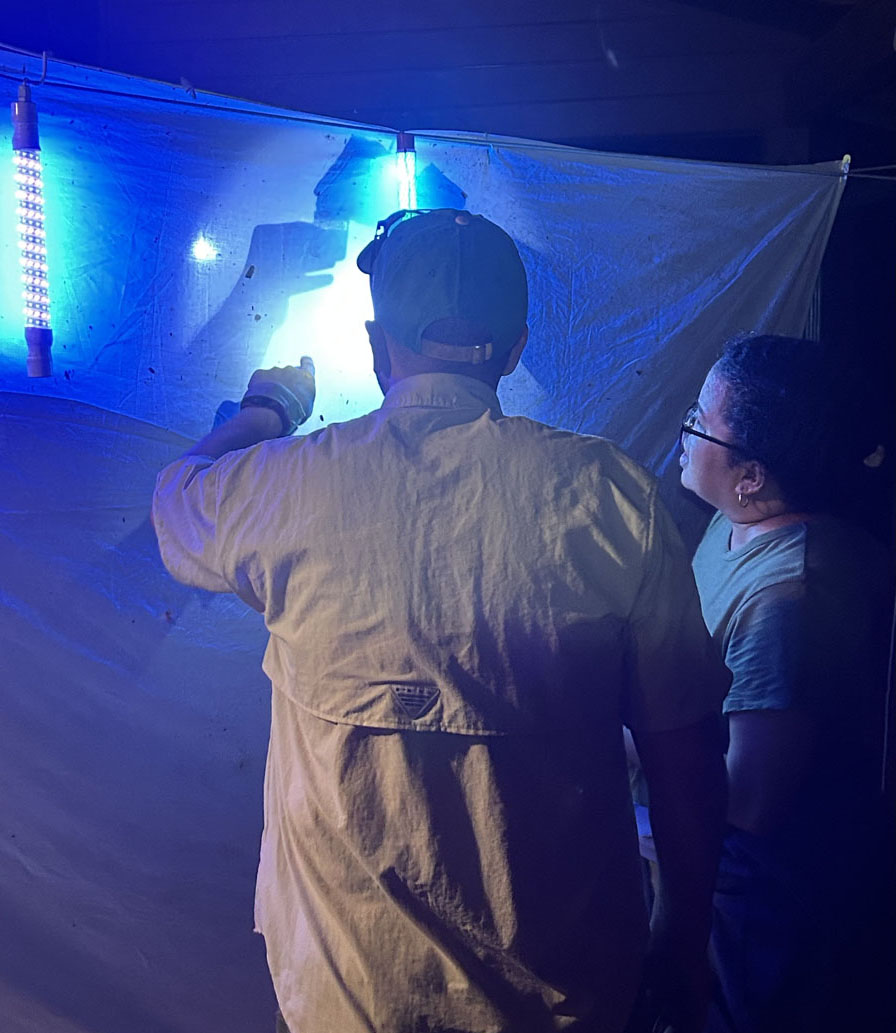
JoVonn and Nicole found something exciting at the cabin porch blacklight trap.
Tuesday, 07 July 2026, Coosa Valley Prairie Easement, Black's Bluff Preserve, Marshall Forest Preserve
On the first morning of the expedition, we drove MSU MEM trucks down pothole ridden gravel roads to a Coosa Prairie remnant surrounded by timber woodland, a part of the Coosa Valley Prairie Easement within Campbell Timberland Management. Immediately the group started collecting with various methods. Nicole crouched along the edges of the gravel road with a sifter and aspirator, in search of any ants to suck up into her vial of ethanol. Phillip set up traps, hoping to uncover bee diversity amongst the Coosa Prairie remnants. Anthony walked instantly into the tall prairie grasses, deploying a sweeping method with his net. JoVonn and Musab were on the hunt for grasshoppers, bounding aplenty across the prairie (both the entomologists and the grasshoppers), while Darby kept her eyes peeled for any surprising mutillids. As I have less of a background in entomology, I decided to do a general survey of the area with sweeping, as well as collecting any ants or beetles I saw scurrying about. It was a great beginning to our insect collecting adventures of North Georgia.
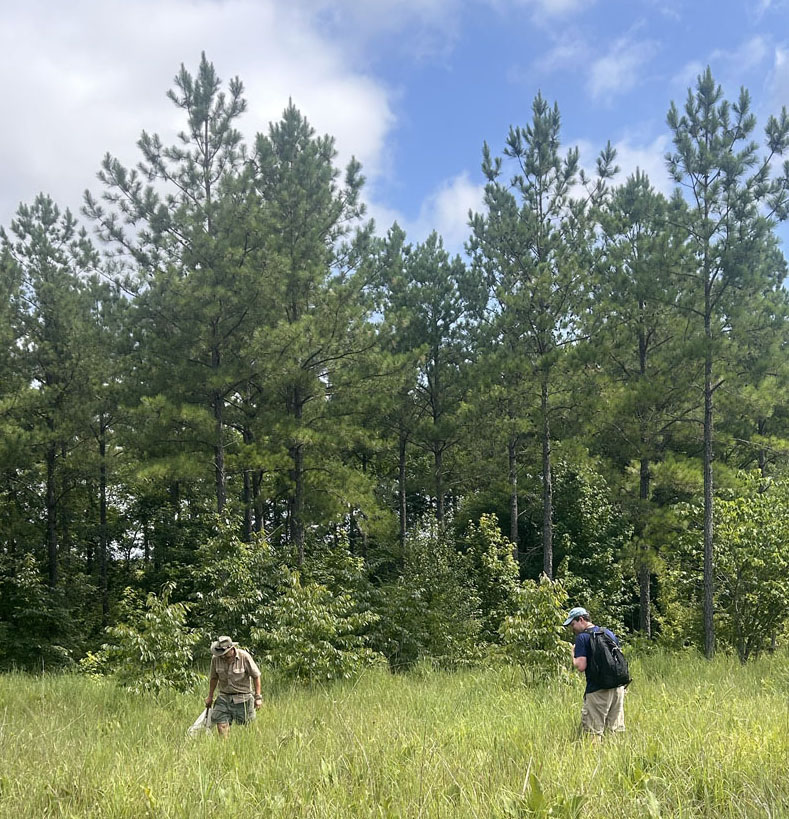
JoVonn and Anthony collecting in the Coosa Prairie grasses.
As it was our first full day of the expedition and spirits were high, we visited the most localities on 07 July. After the Coosa Prairie, we went to Black’s Bluff Preserve (The Nature Conservancy). Black’s Bluff Preserve is part of a mountainous outcrop of Conansauga limestone, known for its unique botanical diversity. We ascended steep cliffs surrounded by hardwood forest and boulders covered with strange looking lichens, mosses, and plants. A highlight after walking in the summer Georgia heat was a cave with cool air we stumbled upon while traversing these trails. Inside the cave we found nymphal camel crickets and flies, as well non-insects such as bats, snails, and a little snake hiding amongst openings on the shelf of the cave.
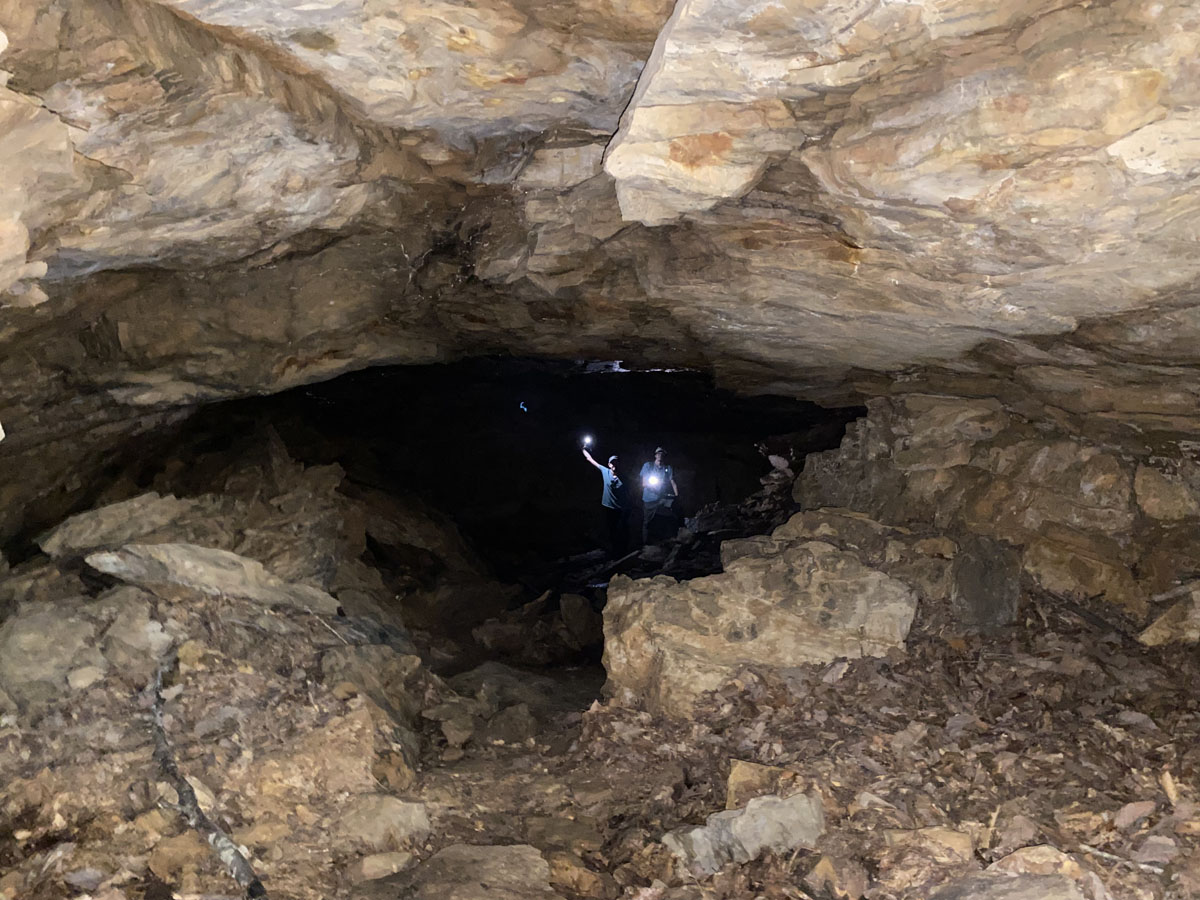
Musab and Joseph cooling off in the cave at Black's Bluff Preserve.
After the cave we naturally split into two groups. One group spent more time collecting around at lower elevation, while another group continued a steep incline to the top of the mountain.
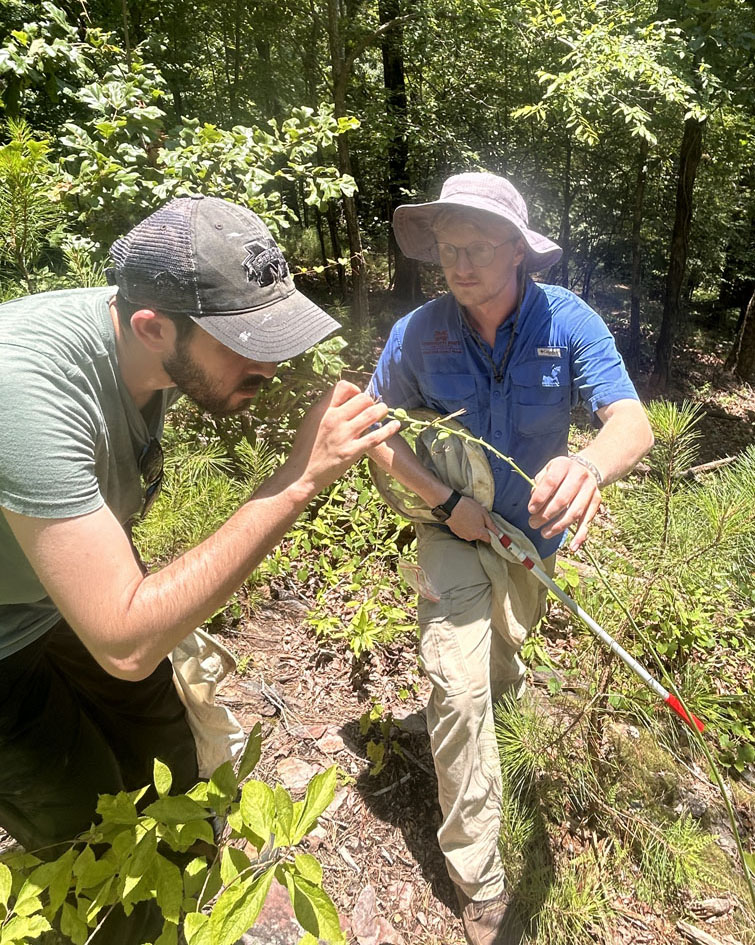
Phillip showing a native agave growing from a boulder to Musab.
After our exploration and collecting at Black’s Bluff Preserve we made a quick trip to Marshall Forest Preserve, though not much insect diversity was found. Still, a short hike in the shade of the pine-hardwood forest made for a nice cool-down before dinner.
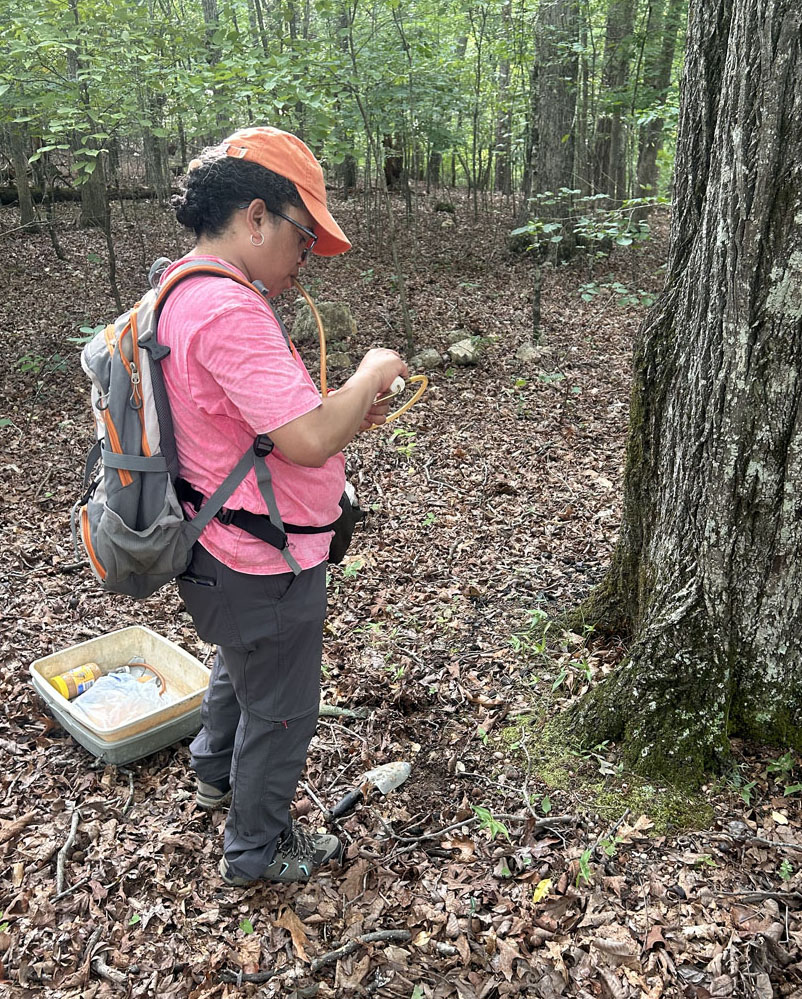
Nicole using her aspirator to catch ants on the first collecting day.
After visiting three localities we were ready for a dinner break. As we were in Floyd County, in the city of Rome, Georgia, we wanted to find something there instead of Chattooga County. While driving through Rome, a burger spot composed architecturally of old airplanes that claimed to have the best burgers in the world caught our eye (for obvious reasons). After some burgers and more tales of past Cross Expeditions at the quirky aircraft themed eatery it was time for another night of blacklighting and traps.
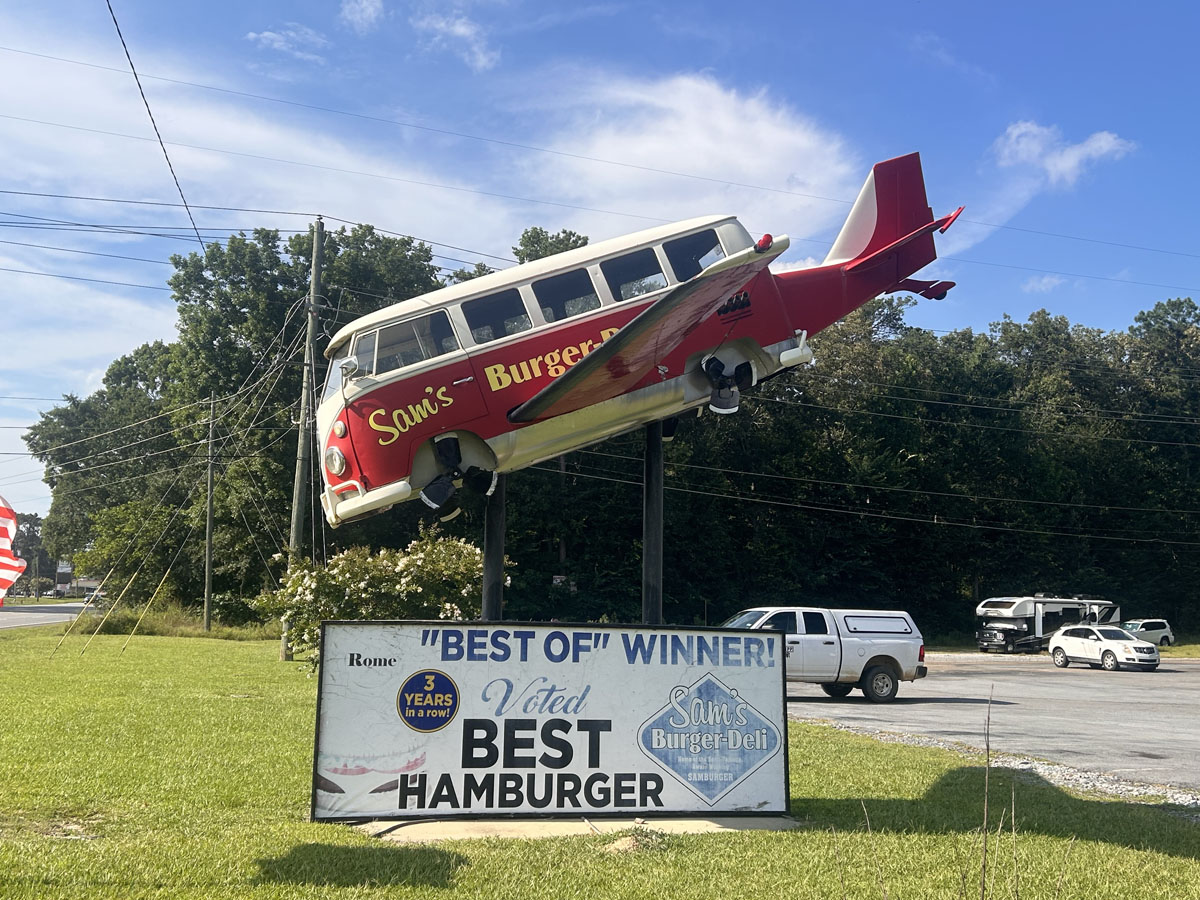
Sam's Burger and Deli sign and bus-plane.
One group set up a bucket trap with a UV light at the Coosa prairie locality. The other group returned to Black’s Bluff Preserve with sheets and blacklights, attempting to find relatively flat terrain in the mountainous habitat for a night of blacklighting. Three blacklight traps were set up. One in the middle of the trail, the second a short distance off the trail, and the third further along in elevation, closer to a rocky stream. After setting up the bucket trap the first group joined the latter for a night of blacklight collecting in the bluffs.
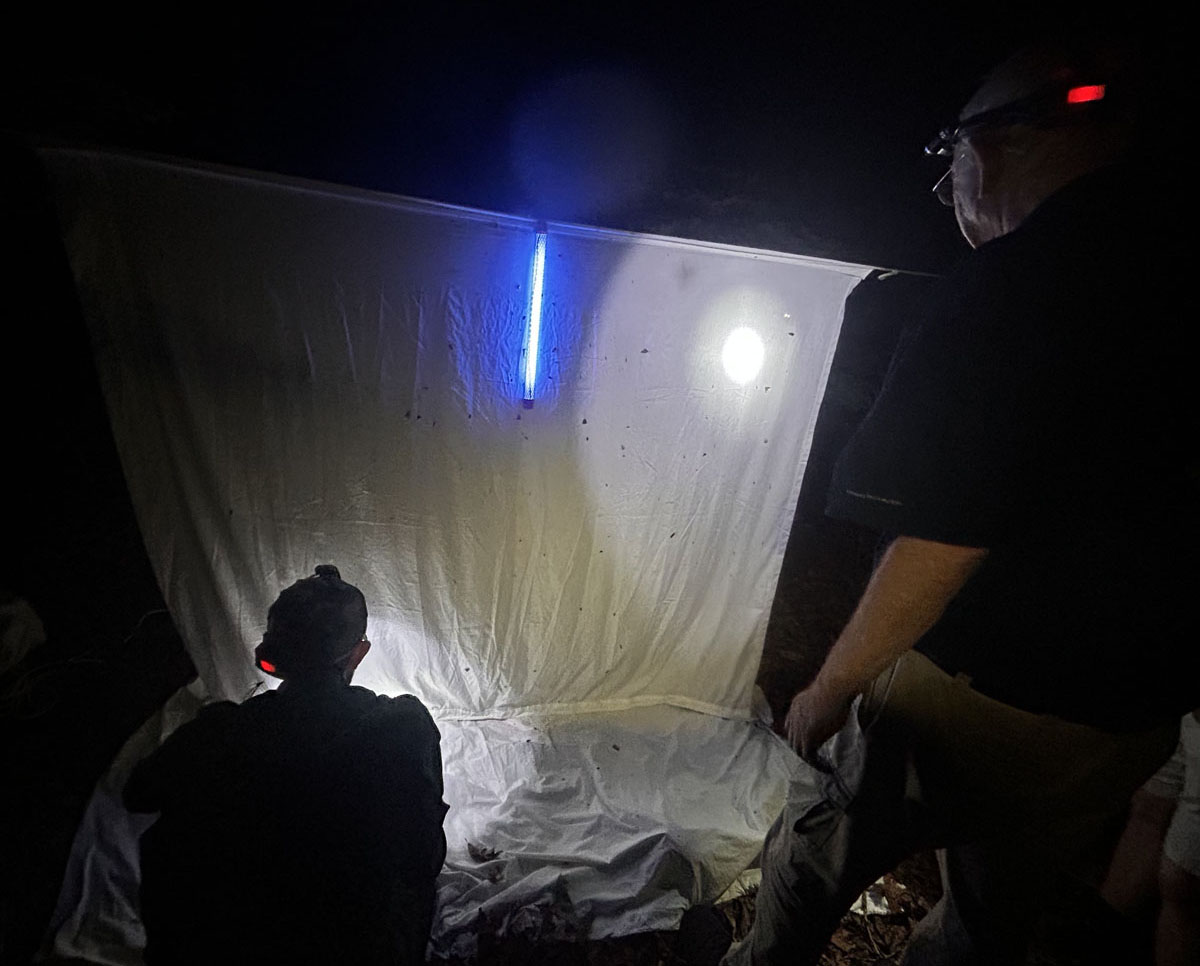
Richard and Musab inspecting a trap.
Wednesday, 08 July 2026, Marble Mine Trail (JHSF), Crockford-Pigeon Mountain Wildlife Management Area (Pettyjohn Cavern)
Early in the morning a small group went back to the Coosa Prairie remnants to retrieve a bucket trap filled with moths. Dr. Richard Brown, an expert lepidopterist, was giddy to find unfamiliar specimens of eucosmine moths and Crambidae. He immediately began going through them and spent the rest of the day dedicated to sorting and pinning moths from the bucket trap.
The rest of the morning was slower going than our first. A group of us decided to take a short hike on a trail at “Sloppy” Floyd State Park that piqued our curiosity, the Marble Mine Trail, which winded up towards an abandoned mine and small waterfall area. It was a short but steep hike that ended with an exposed rock outcrop where a high up little stream emptied into a dramatic pool of clear cool water. We all brought nets and collecting gear in case there were collection opportunities along the way. At the end of the trail, we explored around the rock outcrop to see what life might be hiding in the depressions of the abandoned mine opening, stumbling primarily on bullfrogs and a rather aggressive stag beetle (Lucanus capreolus) that had been relaxing on a stick overlooking the natural pool.
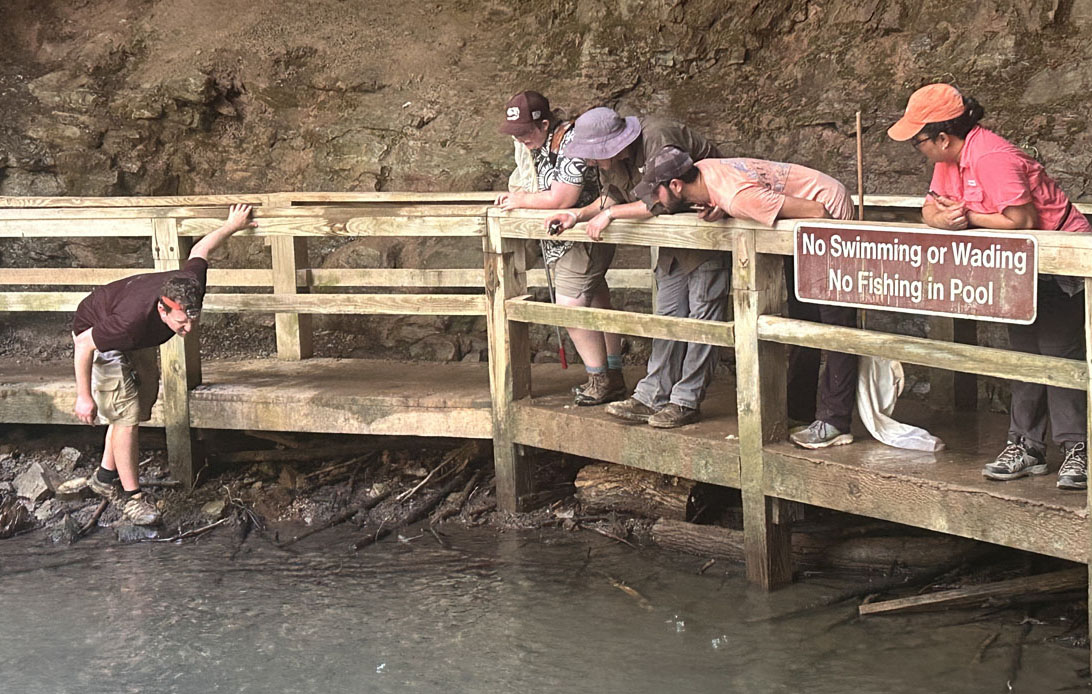
The moment everyone on Marble Trail inspected the stag beetle.
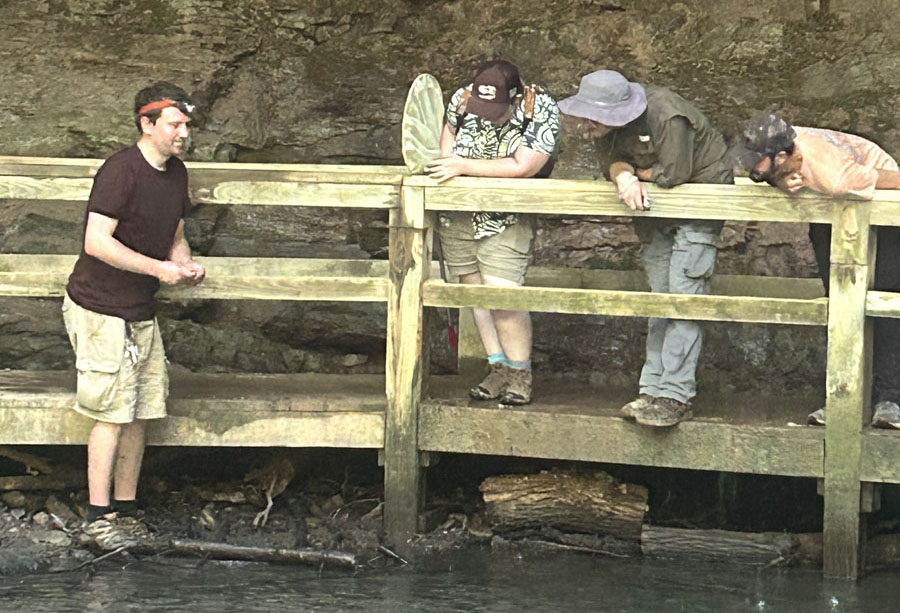
The moment the stag beetle bit Anthony.
After regrouping, we headed to a large new area for potential collecting, the Crockford-Pigeon Mountain Wildlife Management Area. We were trying to scope out a few potential collecting localities along the mountainous roads, a segment of the Cumberland Plateau. Our first stop was on the east side of Pigeon Mountain in the Appalachian Plateau, where we found a trailhead leading to Pettyjohn Cave. Though at first apprehensive of the smooth rock that slipped into a pit of unknown, our curiosity won over and we descended into the mouth of the cave. We crawled through a winding tunnel of sleek, slippery rocks, but it shortly transformed into a large open cave. Our first day at Pettyjohn Cave we mostly appeased our adventurous appetites and only cautiously looked in crevices for hidden life, spotting some flies and cave salamanders, but not staying too long. After climbing back up, we explored and collected along the remainder of the trail, our last collecting locality of the day. After, we drove around Pigeon Mountain in search of more areas to potentially collect from when we came back.
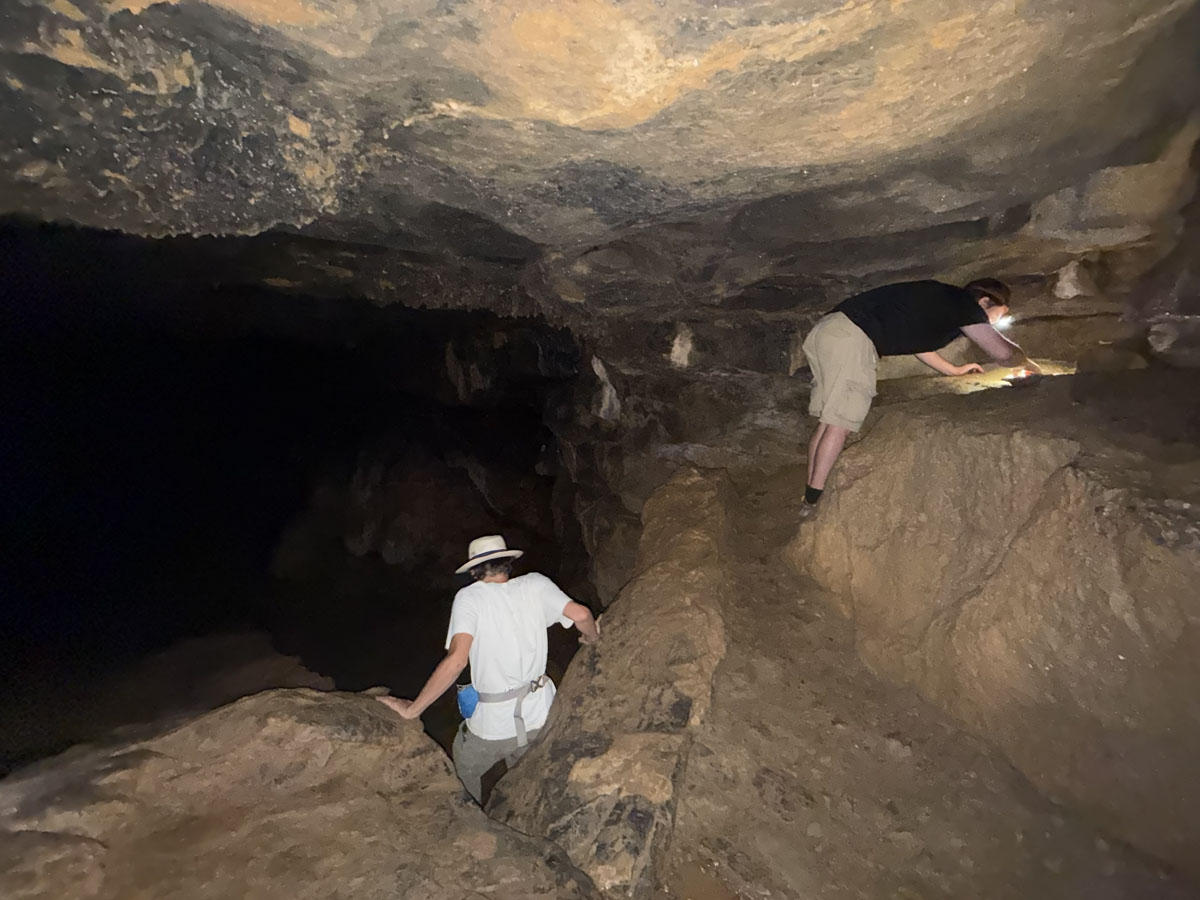
Joseph and Anthony investigating the cave after the winding tunnel.
The rest of Wednesday was spent organizing and decompressing. Most of us looked through what specimens we had collected. Richard remained affixed to his microscope, still admiring moths from the bucket trap. JoVonn had to take Musab to a nearby urgent care, as his reaction to chigger bites had worsened. The rest of the evening we had some much needed rest, especially Musab after his steroid shot and medication.
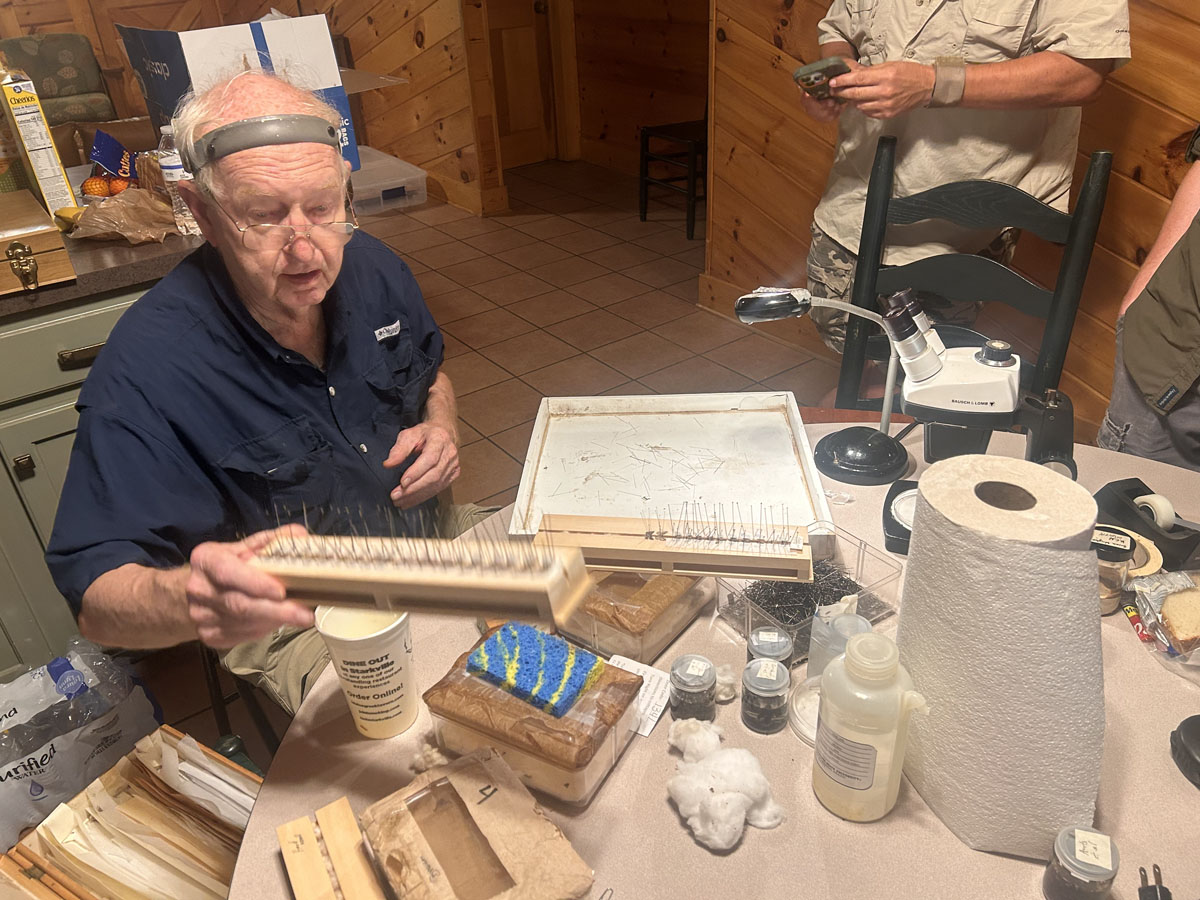
Richard showing off his moth pinning technique.
Thursday, 09 July 2026, Back to Pettyjohn Cave, Rocktown Trail, The Pocket/ Shirley Miller Wildflower Trail, Blue Hole Spring
On Thursday morning we returned to Pettyjohn cave, Rocktown Trail, and the localities we spotted along Crockford-Pigeon Mountain WMA. We first went back to Pettyjohn Cave so Musab, who had severely suffered at the hands of Georgia chiggers and missed out, could experience the descent into the smooth-rock cave himself. We found more salamanders and flies (including Amoebaleria defessa), as well as caught a surprise cave cricket on our way out.
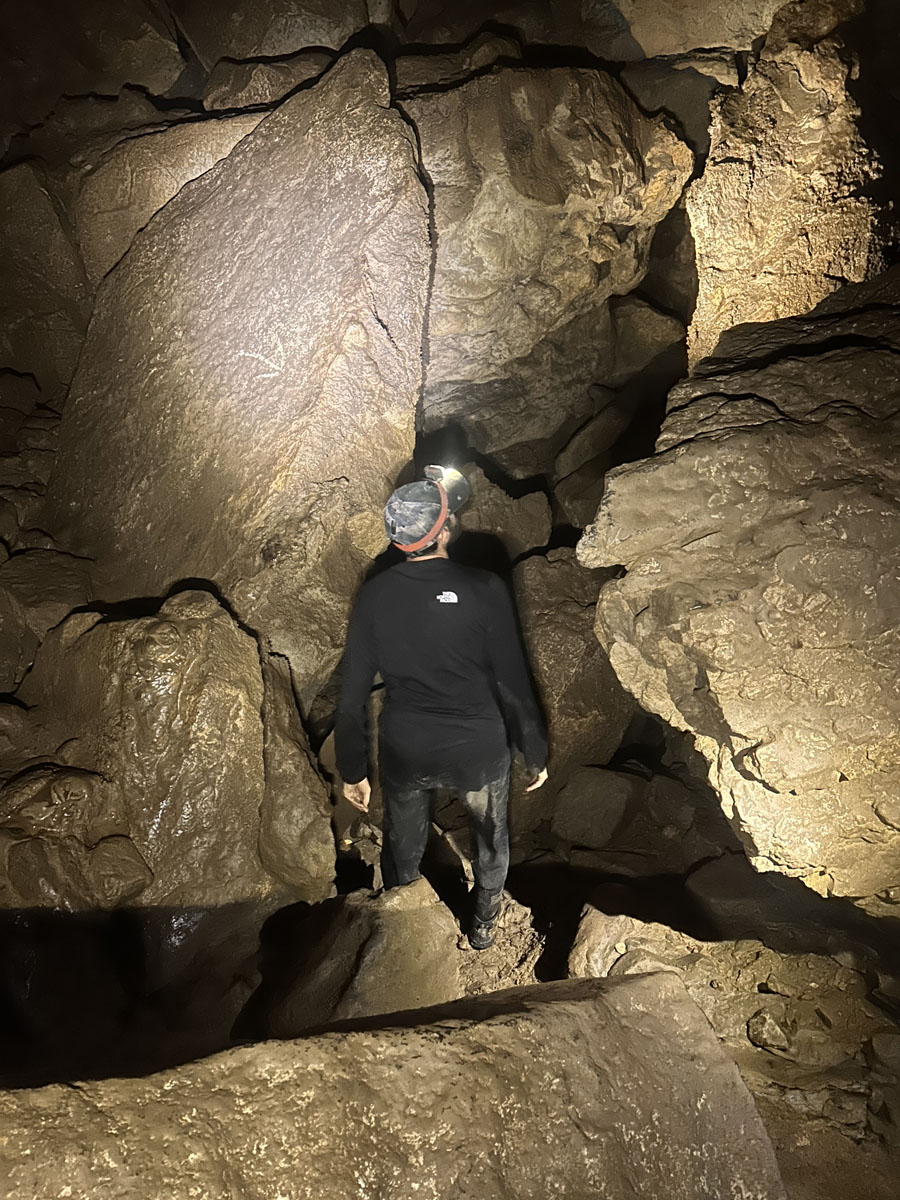
Musab at Pettyjohn cave.
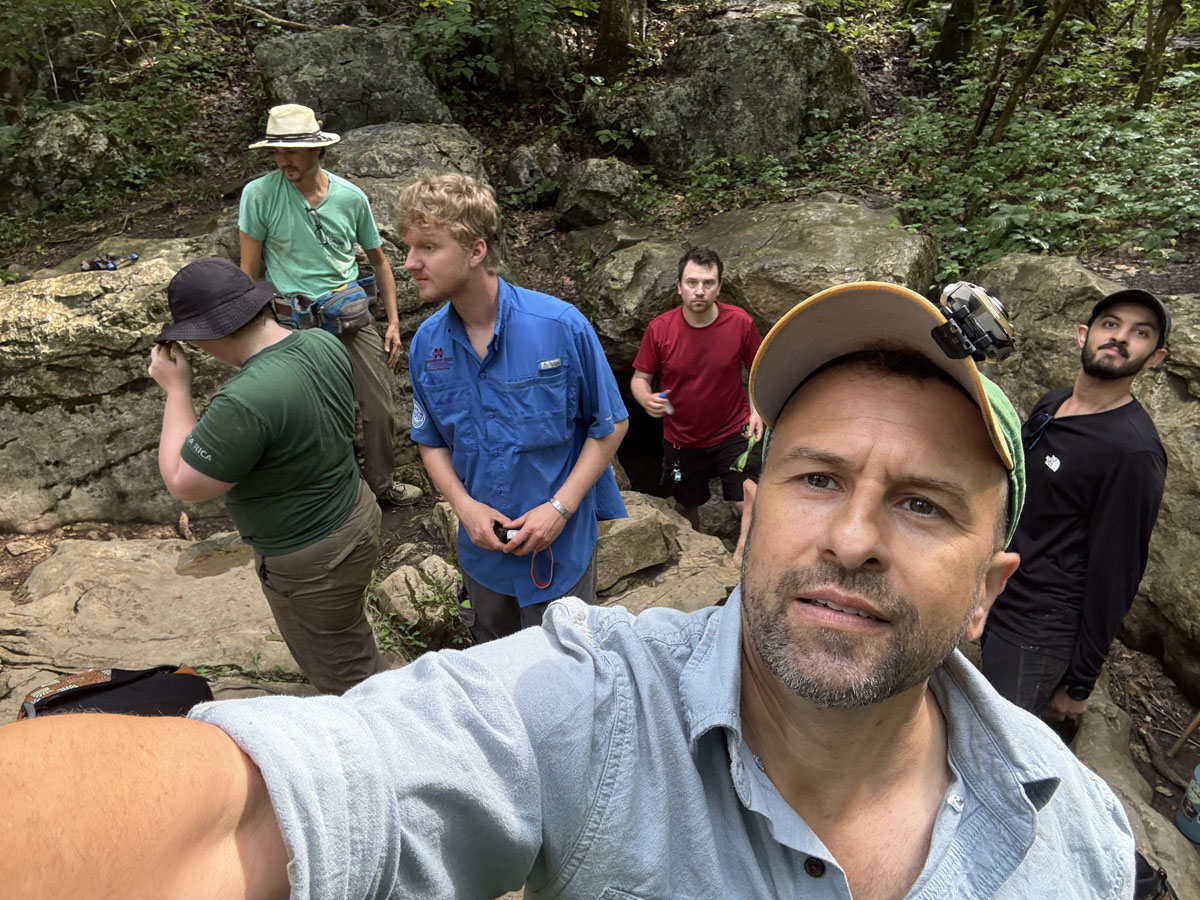
JoVonn's selfie/group picture after we successfully climbed out of the cave.
We then drove further up the steep meandering roads of Pigeon Mountain to a locality we spotted the day before, an open burned field surrounded by hardwood forest. Though the field was not overly diverse botanically, we did uncover a surprising diversity of insects, especially Coleoptera, Orthoptera, and Hymenoptera. Our success of collecting at this locality for the first time was cut short due to an oncoming storm. After organizing what we had under the cover of large hardwood trees, we scrambled back into the MEM trucks. By coincidence, it was a good time for lunch. We descended back down the curvy mountain roads in search of Georgia BBQ.
After our lunch break we had a couple of other localities in the Crockford-Pigeon Mountain area on our itinerary to check out, The Pocket - Shirley Trail area and Blue Hole Spring. The Pocket had a range of habitats to choose from for collecting. There were rocky mountainous wooded sections, a field area with various blooming flowers that attracted an array of pollinators, and most notably the Pocket Shirley Miller Wildflower Trail. While the Pocket Shirley Miller Wildflower trail was not in bloom, it still made for a pleasant hike. Half of the trail was on a boardwalk overlooking a river with large boulders covered in lichens, many damselflies and butterflies fluttering above the gentle streaming water. At the end of the boardwalk the trail became a little more challenging as it turned narrower with rock and log obstacles and started to move suddenly upwards toward the top of a mountain and waterfall. Still, a group of us were determined to make it to the top and see what we might find. Meanwhile, while searching for grasshoppers in open burned hardwood pine forest, JoVonn "stumbled" upon a Timber Rattlesnake. After regrouping he called us all from up on the hill to take in the spectacle of the relaxed sunbathing rattlesnake.
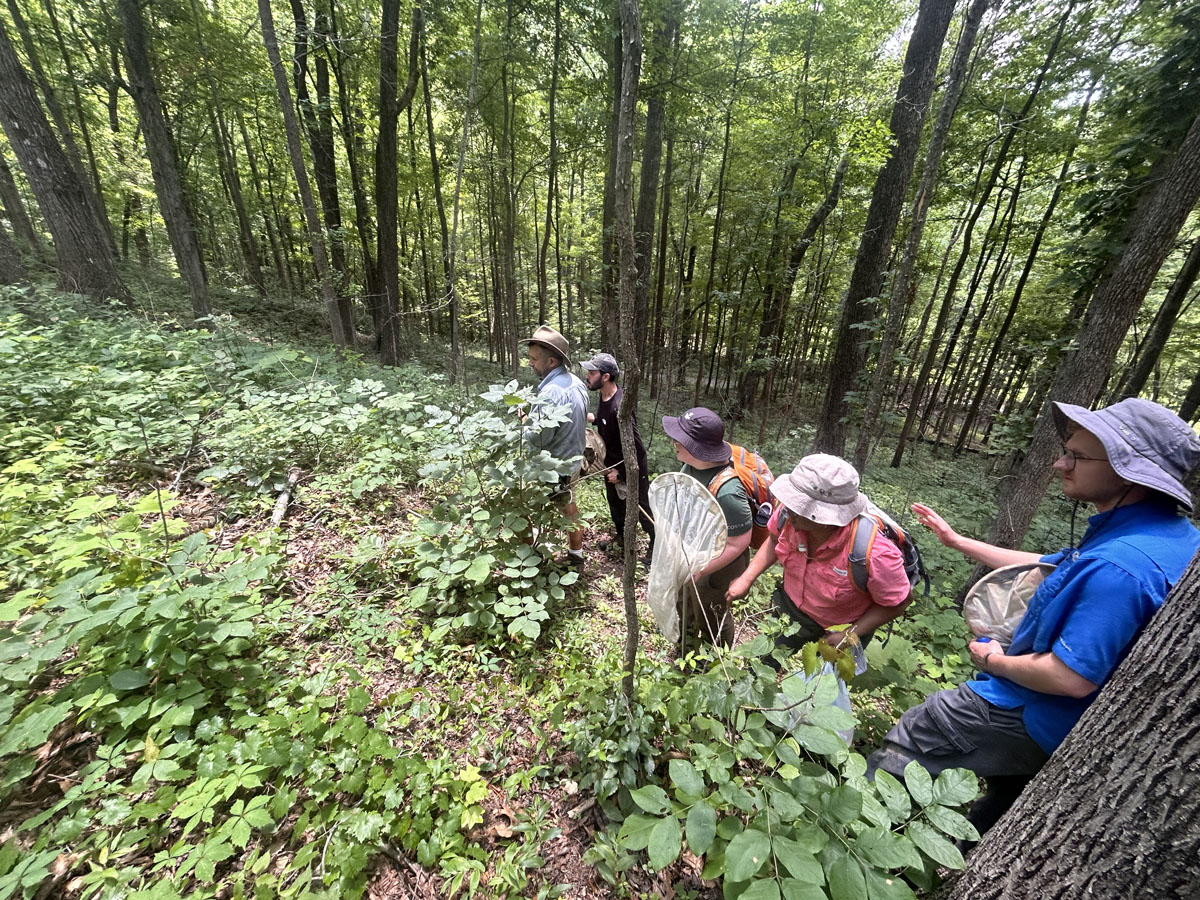
Everyone nervously checking out the Timber Rattlesnake.
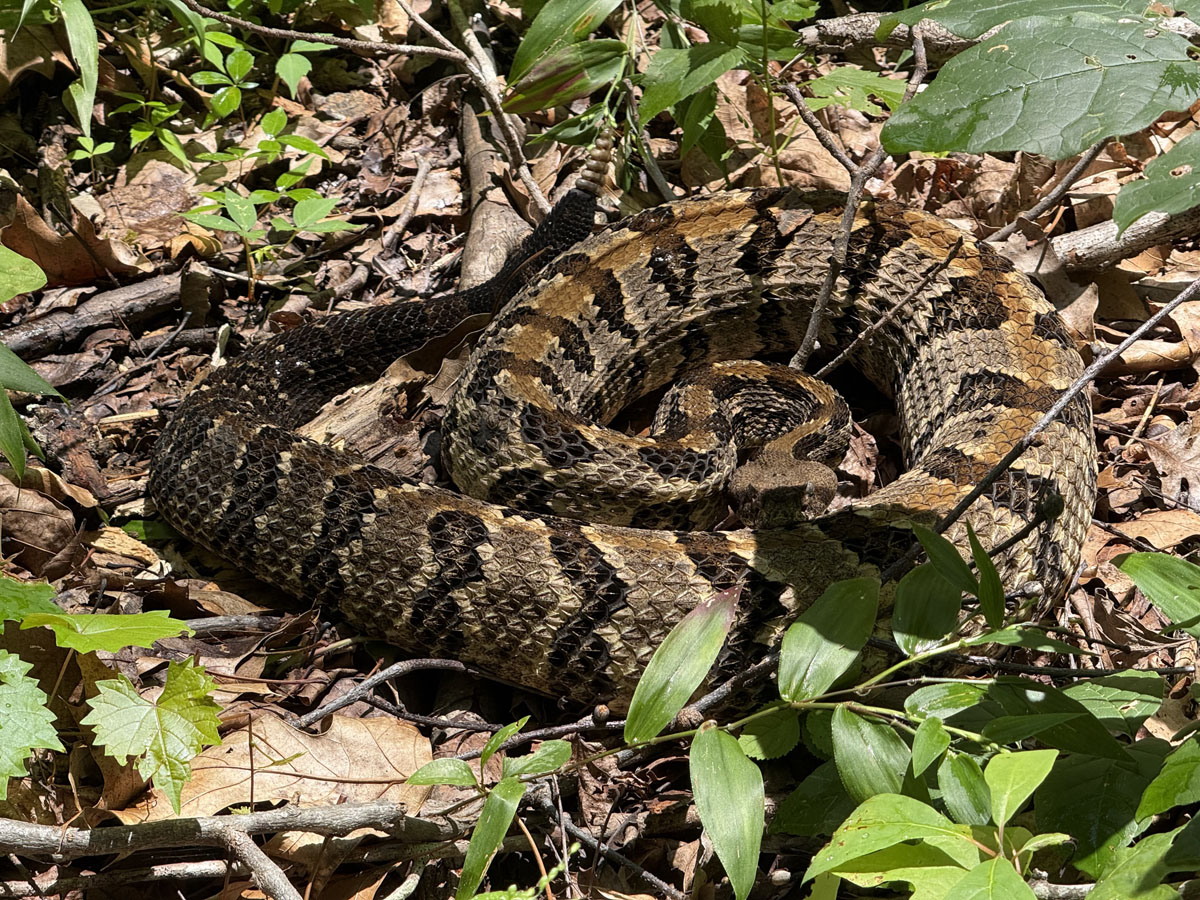
Timber Rattlesnake sunbathing and guarding grasshoppers from JoVonn.
After a day of collecting in the hot Georgia summer we were relieved to visit the last locality on our itinerary, Blue Hole Spring. Blue Hole Spring was a spring-fed creek area surrounded by mesic forest. Some of us dipped into the extremely cold spring water to cool off. Others meandered around the spring water, taking a break but still on the lookout for any unsuspecting insects. Anthony took the opportunity to continue his search for snails, crayfish, and little fish for his varied interests in biological specimens.
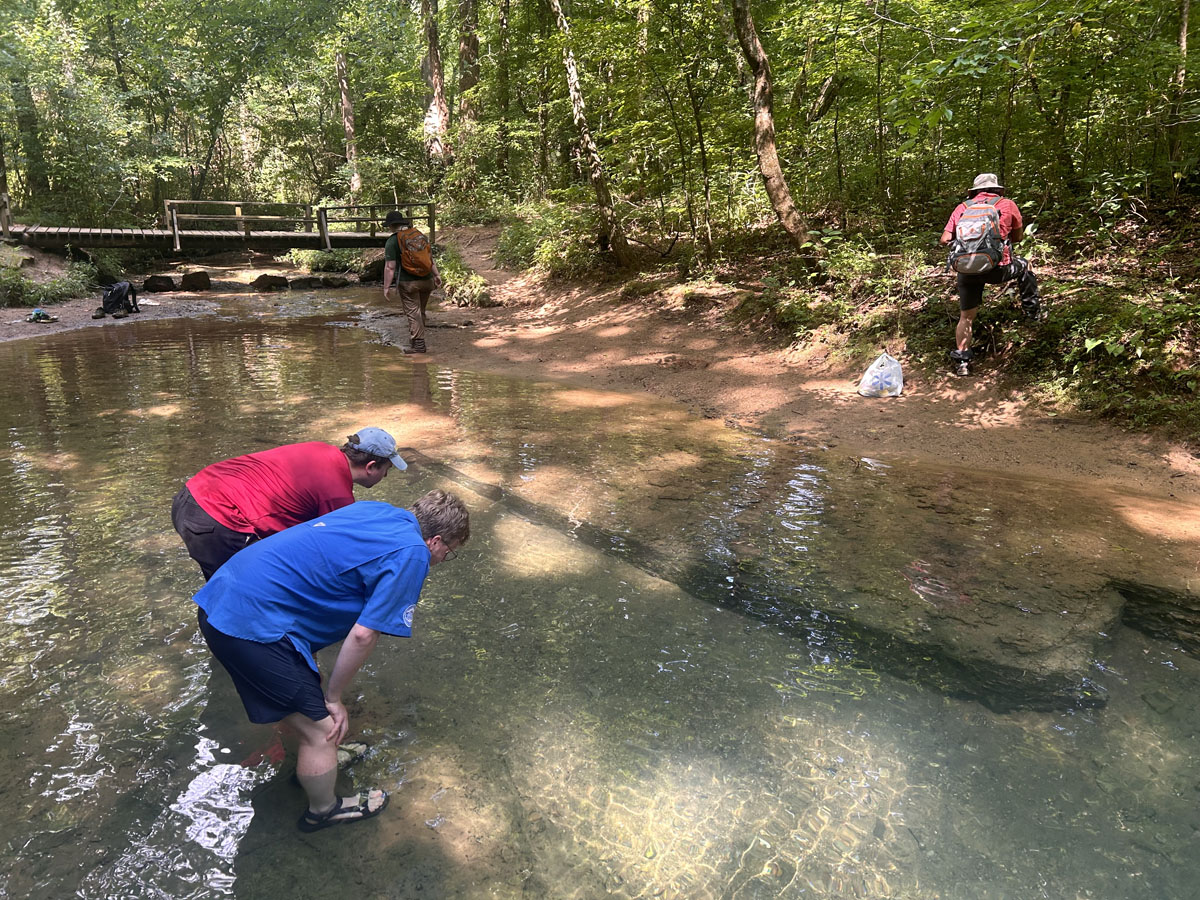
Phillip and Anthony in Blue Hole Spring.
That night was the last night of passive traps. Bee bowls were set up in the open field locality on Pigeon mountain and the UV bucket trap was brought back to the Coosa Prairie because of its previous success. Musab and I walked on Lower Lake Trail behind the cabins in search of grasshoppers along the lake edge. Many took the time to sort through, organize, and identify things collected throughout the Cross Expedition.
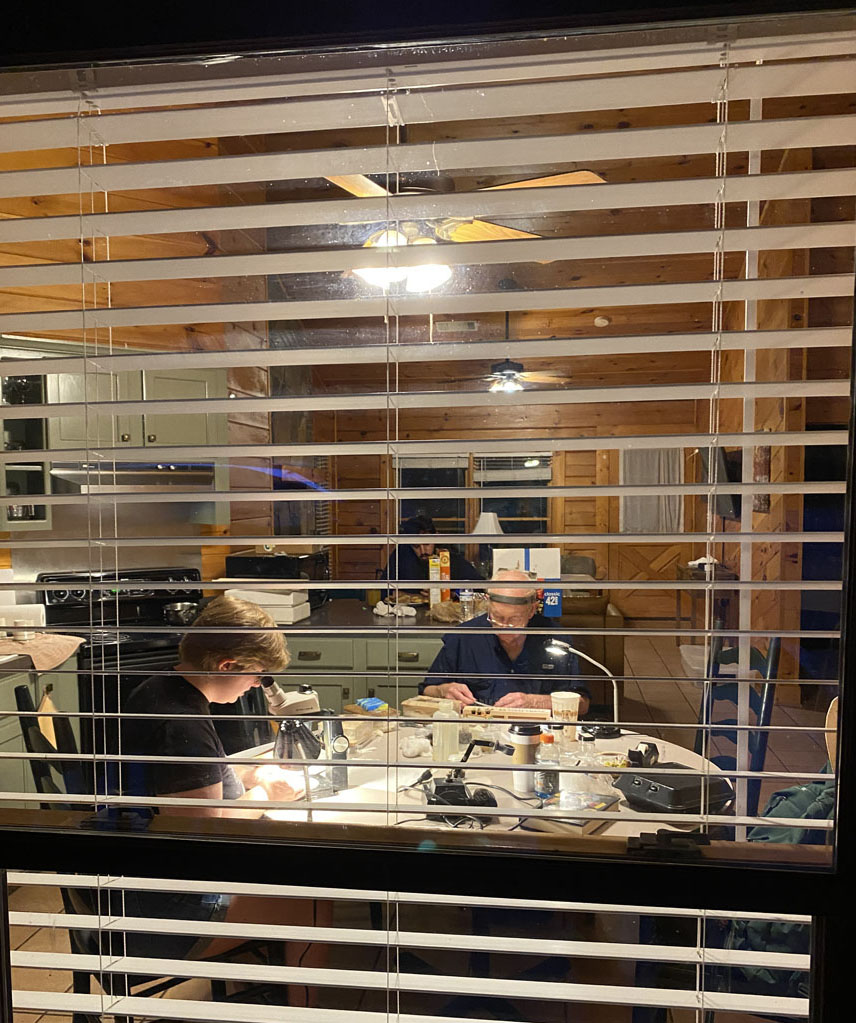
Richard and Darby looking over specimens in the cabin.
Friday, 10 July 2026, Group 1 to Pigeon Mountain, Group 2 to Coosa Prairie Remnants, Howard Finster’s Paradise Gardens
We spent the majority of the last collecting day in separate groups. First thing in the morning one group went to retrieve the UV bucket trap and put out more bee bowls at the Coosa Prairie, while another group went back to the Crockford-Pigeon Mountain area to retrieve bee bowls and do more collecting at various localities around the mountain.
The Pigeon Mountain group (Anthony, Darby, and Nicole) spent more time sweeping and general collecting at the open field locality and more dedicated time collecting on the Rocktown Trailhead. They additionally found another, younger field locality nearby a commercial logging area on Pigeon Mountain. In a meadow in Rocktown, Darby was surprised to collect Dasymutilla gibbosa, a mutilid with a unique distribution. Anthony deployed more sweeping at the various localities and Nicole continued her search for ant specimens. After another day of collecting along the mountain, this group decided they were ready to go back home, so they drove all the way back to the MSU Entomology Museum with their gear and new specimens.
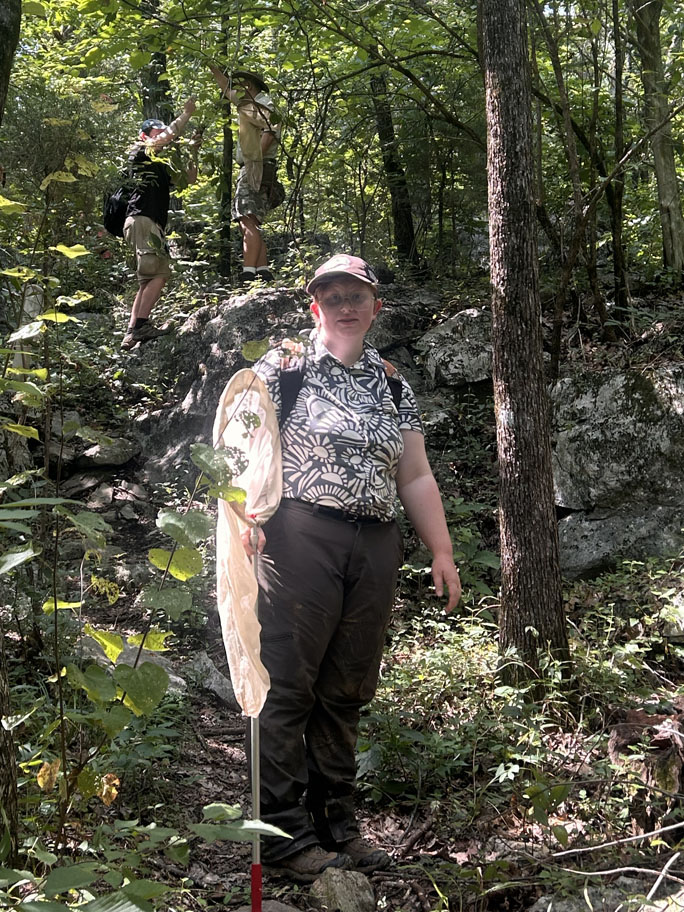
Darby on Pigeon Mountain.
Later in the morning, a Coosa Prairie group (JoVonn, Musab, Phillip, and Joseph) searched for more Coosa Prairie remnants in the same general area as the first locality. The first new locality was overgrown with young pine, so the botanical and insect diversity usually associated with Coosa Prairie remnants suffered. As such, we did not stay very long. We did, however, have better success at the Coosa Prairie powerline locality. This was a semi native grassland on powerline R.O.W. with a gravel road running through it. The powerline locality had an immediately obvious diversity of grasshoppers, which excited Musab and JoVonn. It was nearby, in a section of oak savannah, that JoVonn discovered a relatively rare Paratylotropidia beutenmuelleri. Phillip, the bee specialist among us, uncovered a wide variety of bee species at the Coosa Prairie localities from his traps.
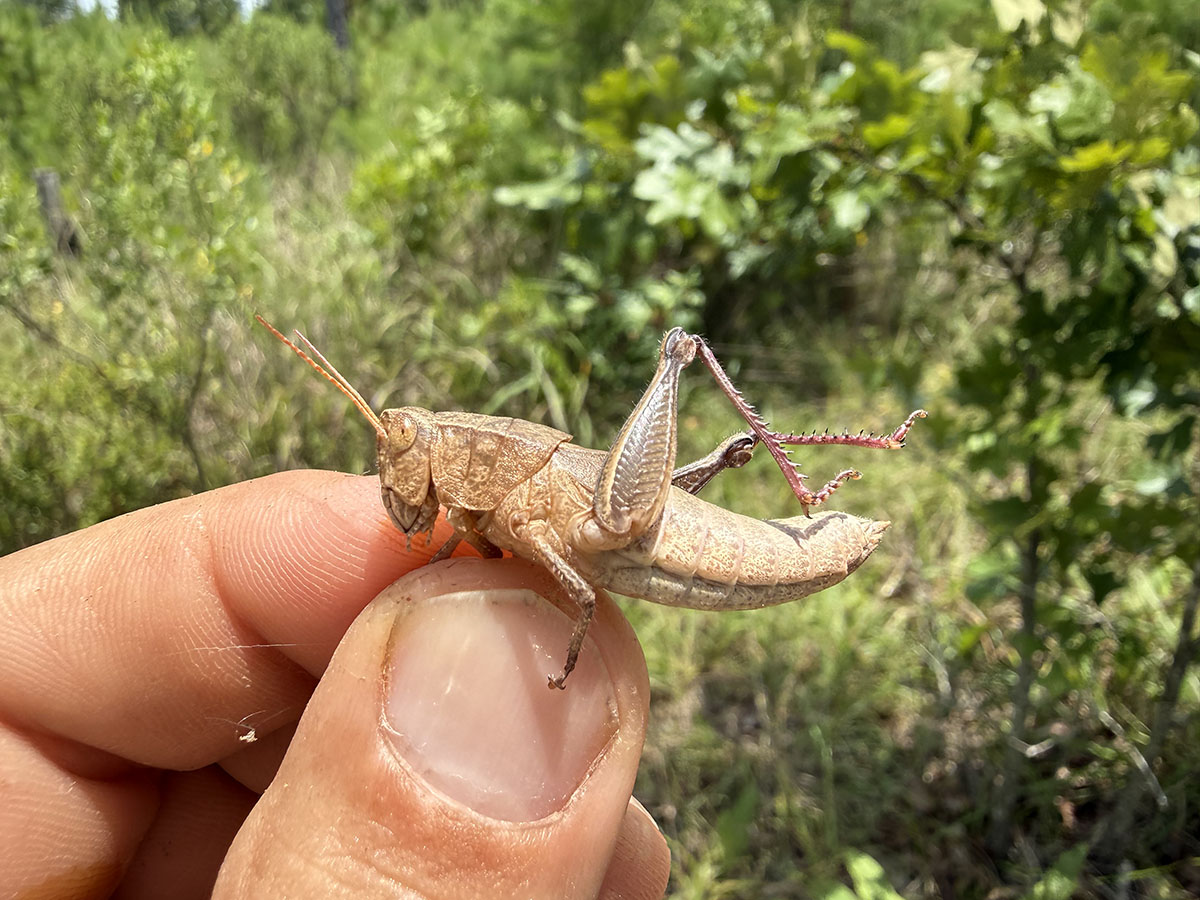
JoVonn holding Paratylotropidia beutenmuelleri.
The latter group engaged in our creative curiosity on the way back to the cabin site. Within just a few miles of “Sloppy” Floyd State Park is the unique historic Howard Finster’s Paradise Gardens. Over the course of decades, prolific artist Howard Finster worked on the Paradise Gardens project, led by a higher calling. As entomologists, we were well received by staff when we arrived at Paradise Gardens. A prominent painting of a red ant hovered over the entrance to the gift shop/visitors center, apparently a common symbol in Finster’s unique visual theological musings. Howard Finster’s serendipitous theological ant inspiration was not the only connection to entomology. The general manager of Paradise Gardens, sporting cicada earrings, had many passionate questions about insects, often pointing with pride to the swamp ecosystem preserved in the garden. JoVonn additionally retrieved specimens from Finster’s infamous Folk Art Church and Phillip was amazed at the various pollinators visiting flowers in the garden. This made it the unexpected final locality of the 2026 William H. Cross Expedition.
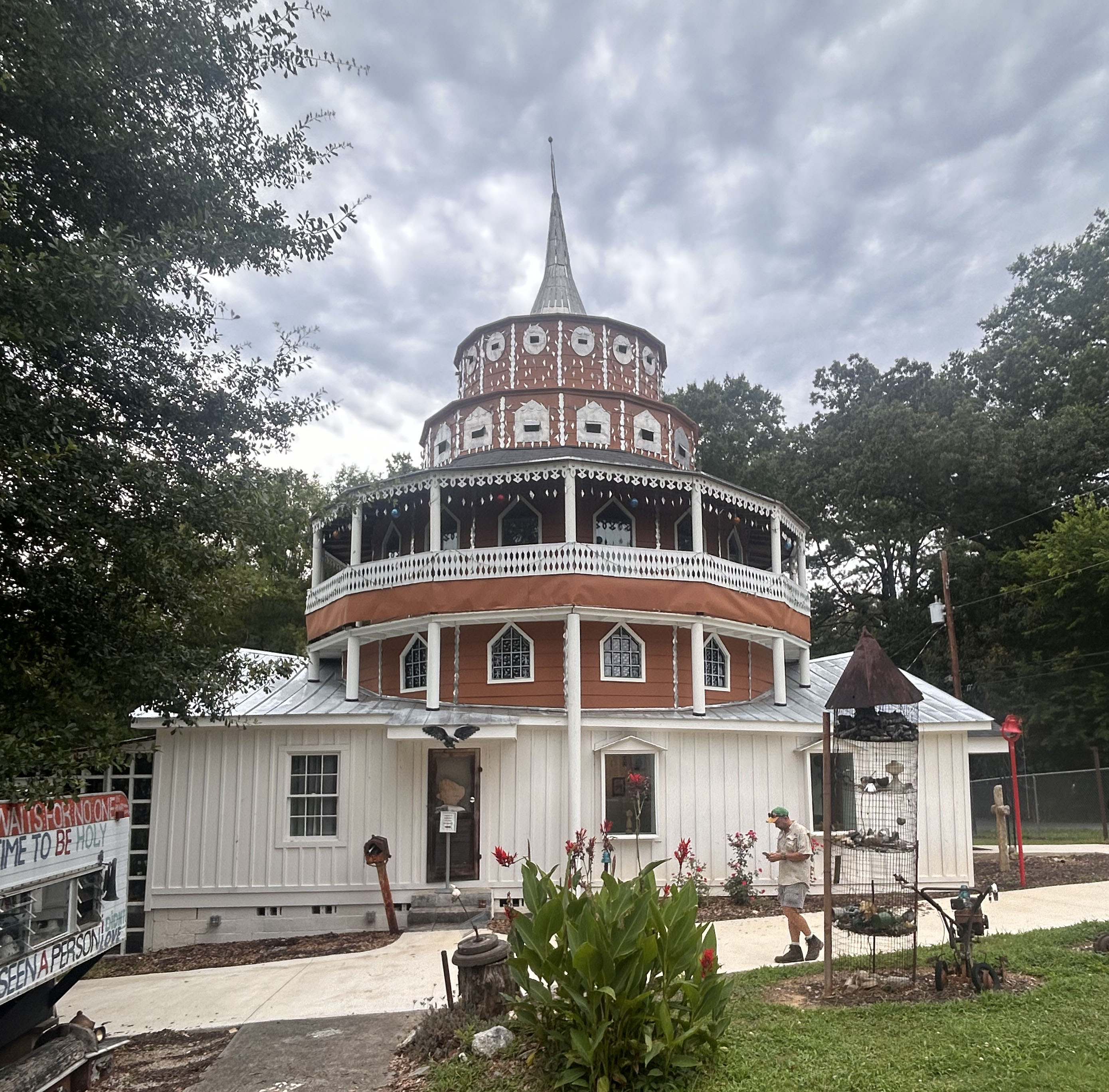
JoVonn in front of Finster's Folk Art Church.
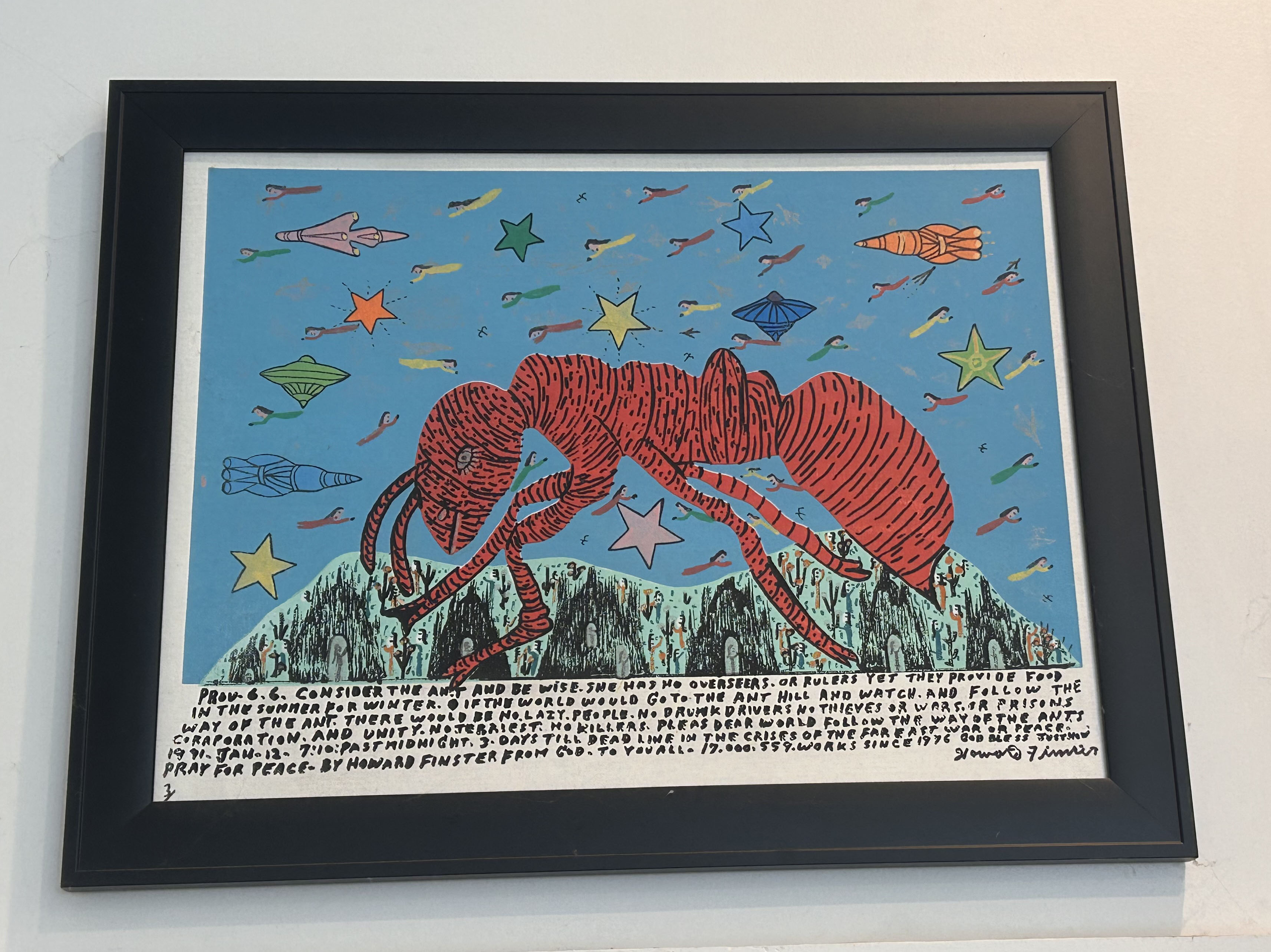
Finster's ant hanging at the entrance of Paradise Gardens.
Next, was the final sorting, identifying, labelling, and pinning of specimens collected, of course, all labeled as “William H. Cross Expedition”.
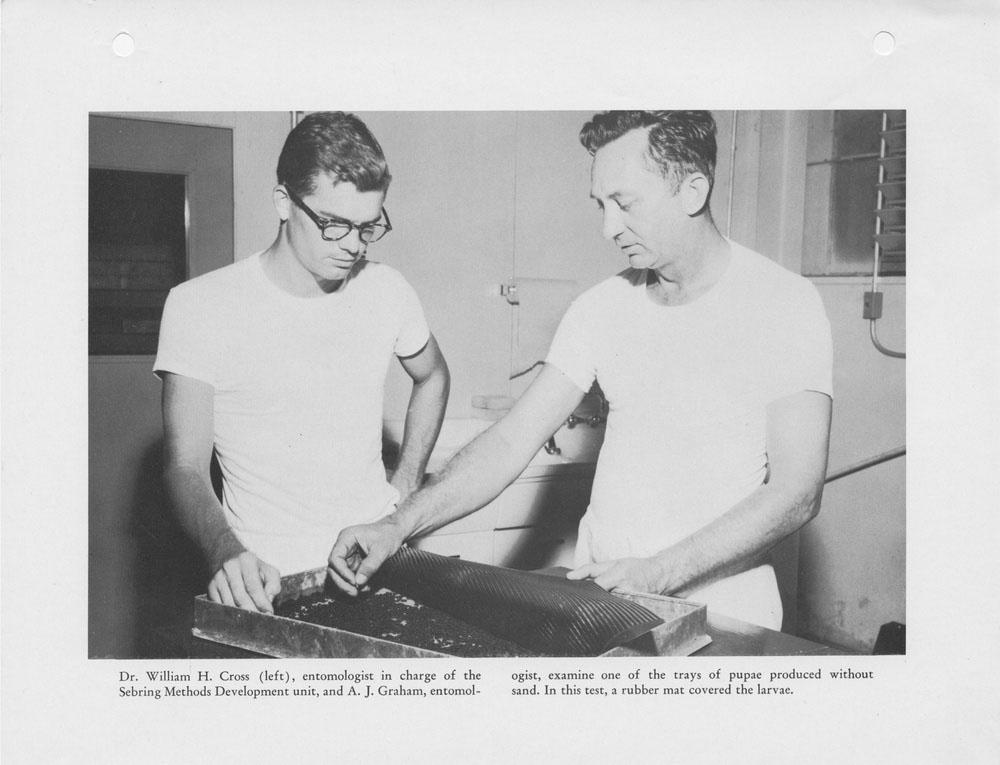
An old image of a young Dr. William H. Cross.
Collecting Sites
Floyd State Park Cabin area
USA, GA., Chattooga Co.
James H. “Sloppy” Floyd SP
34.4373 -85.3405
Blacklight
Mercury Vapor light
Malaise trapb
Mixed hardwood/pine forest
Floyd State Park trail
USA, GA., Chattooga Co.
James H. “Sloppy” Floyd SP
34.4289 -85.3327
Marble Mine Trail
Mixed hardwood/pine forest
Coosa Prairie “Campbell Timber Management”
USA, GA., Floyd Co.
5 mi NW Cave Spring
34.1347 -85.4174
Coosa valley
prairie
Box trap in
Coosa Vally
prairie
Bee bowls in
Coosa Valley
prairie
Blue Vane Trap
In Coosa Valley
prairie
Blacks Bluff Preserve
USA, GA., Floyd Co.
Black Bluff Preserve
34.2093 -85.2191
7 July 2026
N side Walker Mountain
limestone-influenced
moist hardwood forest
N side Walker Mountain
Cave in Limestone-moist
hardwood forest
Marshall Forest Preserve
USA, GA., Floyd Co.
Marshall Forest Preserve
34.2446 -85.1958
NE side Horseleg
Mountain mixed
pine-hardwood forest
Crockford-Pigeon Mountain WMA 1
Pettyjohn’s Cave
USA, GA., Walker Co.
Crockford-Pigeon Mountain
WMA, 34.6648 -85.3628
Pettyjohn’s Cave
Pigeon Mountain
Crockford-Pigeon Mountain WMA 2
Across from Campground near Rocktown
USA, GA., Walker Co.
Crockford-Pigeon Mountain
WMA, 34.6655 -85.3847
Open field on
Pigeon Mountain
Open burned
Hardwood forest on
Pigeon Mountain
Crockford-Pigeon Mountain WMA 3
Pocket Shirley Trail
USA, GA., Walker Co.
Crockford-Pigeon Mountain
WMA, 34.7125 -85.3795
Pigeon Mountain
Ruderal vegetation
On edge of woods
Pigeon Mountain
open burned hardwood-
pine forest
Crockford-Pigeon Mountain WMA 4
Blue Hole Spring
USA, GA., Walker Co.
Crockford-Pigeon Mountain
WMA, 34.7026 -85.3390
Spring-fed creek
Mesic forest
Adjacent to
Spring-fed creek.
Crockford-Pigeon Mountain WMA 5
Rape Gap
USA, GA., Walker Co.
Crockford-Pigeon Mountain
WMA, 34.6444 -85.4038
Open field on
Pigeon Mountain
Crockford-Pigeon Mountain WMA 6
Rocktown Trailhead
USA, GA., Walker Co.
Crockford-Pigeon Mountain
WMA, 34.6586 -85.3900
Open Hardwood forest
on Pigeon Mountain
Coosa Prairie Powerline
USA, GA., Floyd Co.
5 mi NW Cave Spring
34.1347 -85. 4174
10 July 2026
Semi-native
grassland on
powerline R.O.W
Howard Finster’s Paradise Garden
USA, GA., Chattooga Co.
Summerville
34.5129 -85.3162
10 July 2026
J.G. Hill
Below window
in structure with
many piles of frass
Finster’s Paradise
Garden